
Trust the Mask was born as a reaction to an anesthetized world, a project that seeks to break the routine and indifference through an electronic sound that blends darkness and dance tension. Trust the Mask uses music as an outlet, a celebration, and a rite of atonement.
The duo, consisting of Elisa Dal Bianco (violin, electronics) and Vittoria Cavedon (vocals), released “Idiom” (2023, Bronson Recordings), their first album, which was well received by the national and international press. It was performed live in over 50 gigs, including festivals such as Color Fest, Ypsigrock, Santarcangelo, White Show for Milan Fashion Week, Passatelli in Bronson, and others. Trust the Mask opened for artists such as Daniela Pes, Anna Calvi, Ninos Du Brasil and Editors.
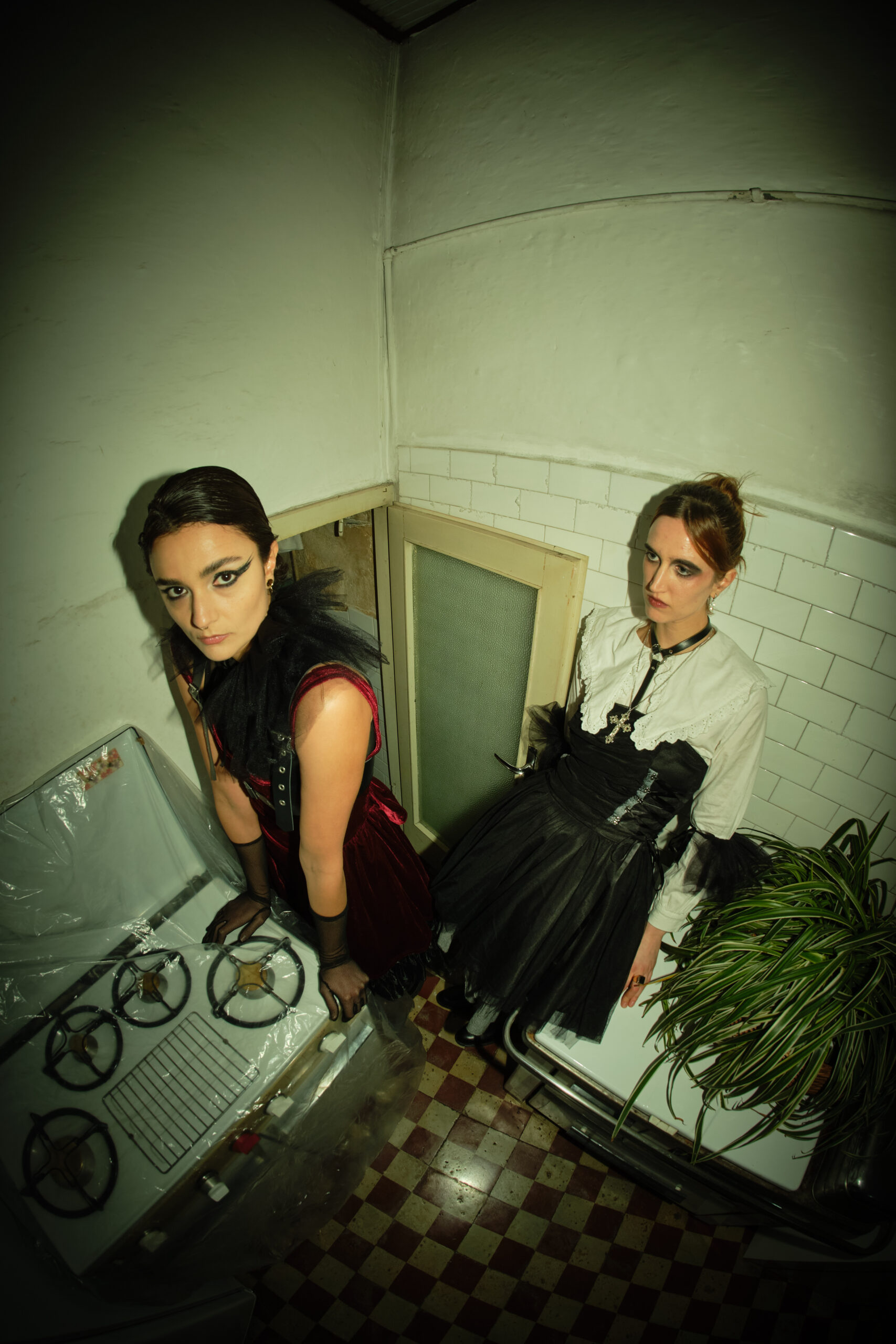
Explain the meaning behind your band name “Trust the Mask.”
If you think about it, depending on where we are and who we’re in front of in our daily lives, we reveal different sides of ourselves. It’s inevitable. Our social self never fully aligns with what we truly feel inside. In a way, we wear a mask, in fact, many masks. Yet we believe there is a place where those masks fall away: artistic expression. On stage, we don’t adapt, we don’t filter, we don’t protect ourselves. We are fully present, stripped down to our truth. “Trust the Mask” was born from this very paradox. The mask is what we wear every day, but it’s also what breaks through art. And what we ask of those who watch us is to trust the truth they see on stage, and perhaps to feel empowered to do the same, at least for as long as they’re with us.

Do you create music from a place of isolation, or dialogue with each other?
We like to begin with a story to tell. We choose stories that resonate with us, that reflect what we’re living through or something we’re feeling at that moment. Usually, the initial spark comes from one of us, followed by a first exchange where that emotion is shared with the other. It’s almost like narrating a film: once we’ve visualized the imagery of that story, we tend to write separately, so we can each fully express our own version without influencing or contaminating the other’s creative process. After that, we come back together to review the work as a whole, and then come the endless revisions. Sometimes it happens that we’re simply not in the same mood and It’s fascinating to hear that contrast between the musical composition and the vocal lines. We’re drawn to the way our interpretations of the same feeling blend together in what might seem like a forced way, that tension has become part of our signature style.


You met in early 2020- a moment when the world was shutting down. How did that timing shape your collaboration?
The pandemic gave us the time and focus we needed to devote ourselves to this project with a spirit charged with expressive intensity. We were constantly sending each other beats, lyrics, ideas, sounds, rough vocal recordings and with patience and a deep sense of sharing, we built the structures of what would eventually become the tracks on Idiom, even from a distance. If we had to describe that period, we’d say it was the cradle of our first songs, but also of our mutual trust and the foundations of our collaboration. That’s when we realized we truly worked as a duo.

How do you know when a track is finished? Do you ever leave something unresolved intentionally?
This might be our Achilles’ heel: we are two people in constant evolution, both in terms of taste and emotion. We can move from visceral anger to euphoria in just a few days, and we want everything we create to transform along with us. When we listen back to a track, we consider it finished only if we both feel that we’ve conveyed our original intention. To get there, we use each other as mirrors, as a point of reflection and confrontation. At the same time, we try to approach it more rationally, asking ourselves: Would we genuinely enjoy playing this live? Does it contain all the elements that represent us? If the answer is yes, we close the composition, but the process is long.
We’re also both very instinctive and impatient, which means we sometimes record takes in the heat of the moment without being technically precise. For example, it happened that we recorded with cheap microphones and later had to re-record everything in the studio to achieve the quality we wanted. That obviously extends the timeline, and at times it feels like a track may never truly be finished. But that’s also the exciting part: during the reworks, ideas accumulate, and often it’s the track itself that tells us when it’s ready.

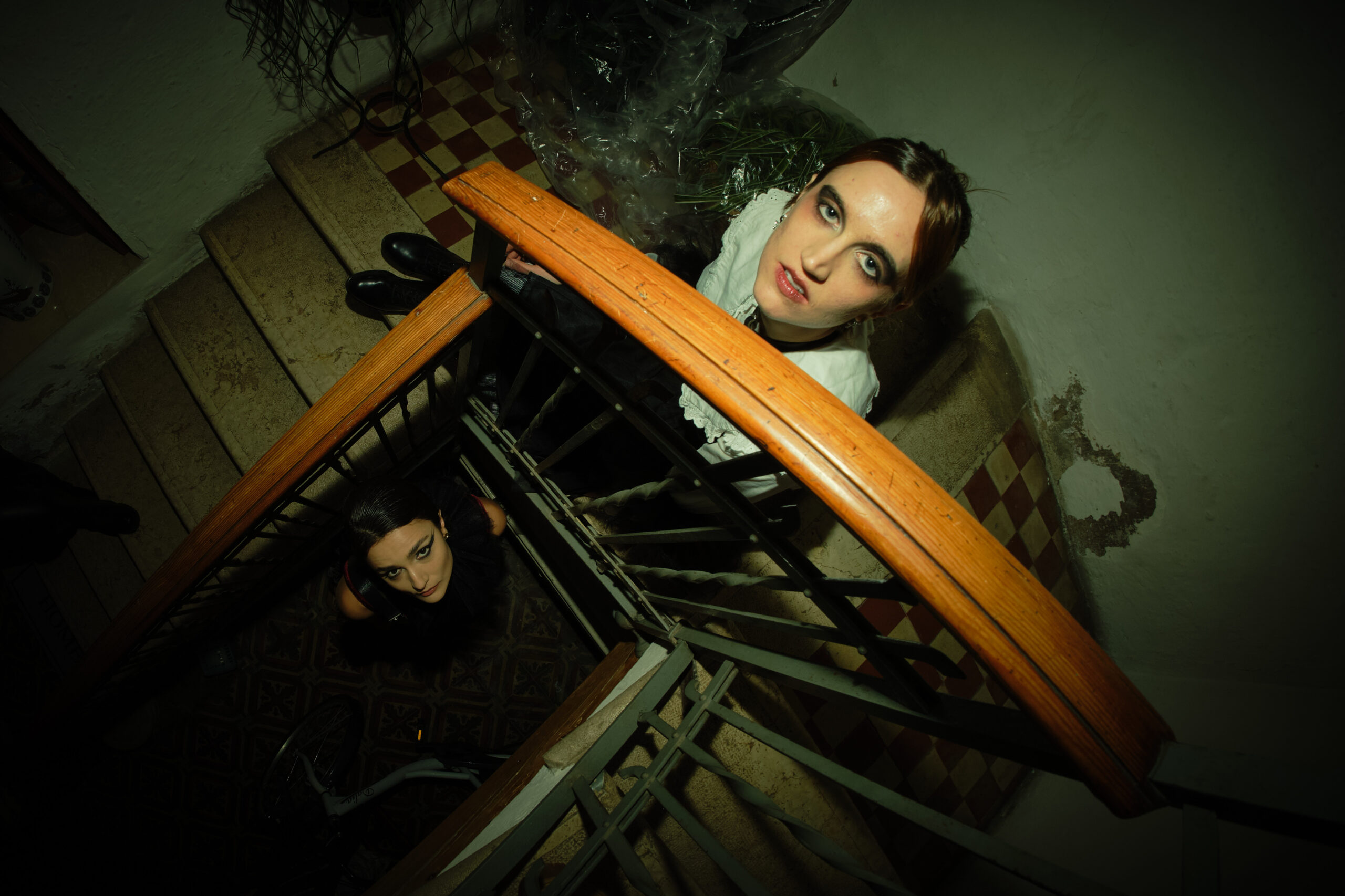
Looking back, what does Idiom reveal about who you were at that time, and how do you feel about it now?
Idiom was an adventure and a revelation for us. It’s our debut album, recorded during an artistic residency with Bronson Recordings in Ravenna. We worked alongside two incredible figures: Bruno Dorella (OvO, Ronin, Bachi da Pietra) and producer Andrea Cola, as well as collaborators Matteo Vallicelli (The Soft Moon), R.Y.F. and Cemento Atlantico. It was our first experience spending entire days together in full musical immersion, instead of our traditional nine-hour office routines.
We arrived with demos that were already well defined, so we already felt that Idiom was our creature. But the most meaningful part was the process itself: growing as a band, affirming ourselves as musicians and vocalists, and sharing that space with established professionals in the field. Looking back, Idiom feels like a snapshot of two musicians stepping into the professional music world for the first time, with something urgent and powerful to express. Today, we see it as a moment of genuine awareness: the beginning of the path toward what we want to become.

Is there a show that altered your understanding of yourselves as performers?
In 2023 and 2024, we played extensively across Italy, and every single show reshaped us in some way. The most memorable one we can mention took place in Venice, at Venezia Open Stage, where we found ourselves dancing together with the entire audience. People completely surrendered to our tracks, they were so charged with adrenaline that we realized we wanted to have even more fun with them from that moment on. That experience pushed us to write songs with faster BPMs, a stylistic choice we embraced for our second album, ITCH, set for release in April with the label Costello’s Records and under the management of Expolive Project, in an attempt to recreate that same atmosphere over and over again.
At our shows, we want what people experience with us to feel like a dark celebration.

If someone listens to Trust the Mask alone, in the dark, what do you hope they feel?
In total darkness, our tracks would still convey all the power and anger we’ve poured into them.
We’d love a solitary listening experience to allow the full meaning of the lyrics to surface, because when you compose dark-electro music that drives people to dance, the words are often overlooked. Ideally, the listener would move through conflicting emotions, oscillating between rage and exhilaration, sadness and relief and yet come out of it with a sharp sense of clarity. We want Trust the Mask to feel like an awakening for those who listen: a jolt against an anesthetized, apathetic society, a signal exchanged between those who resist and who still know how to truly feel.
