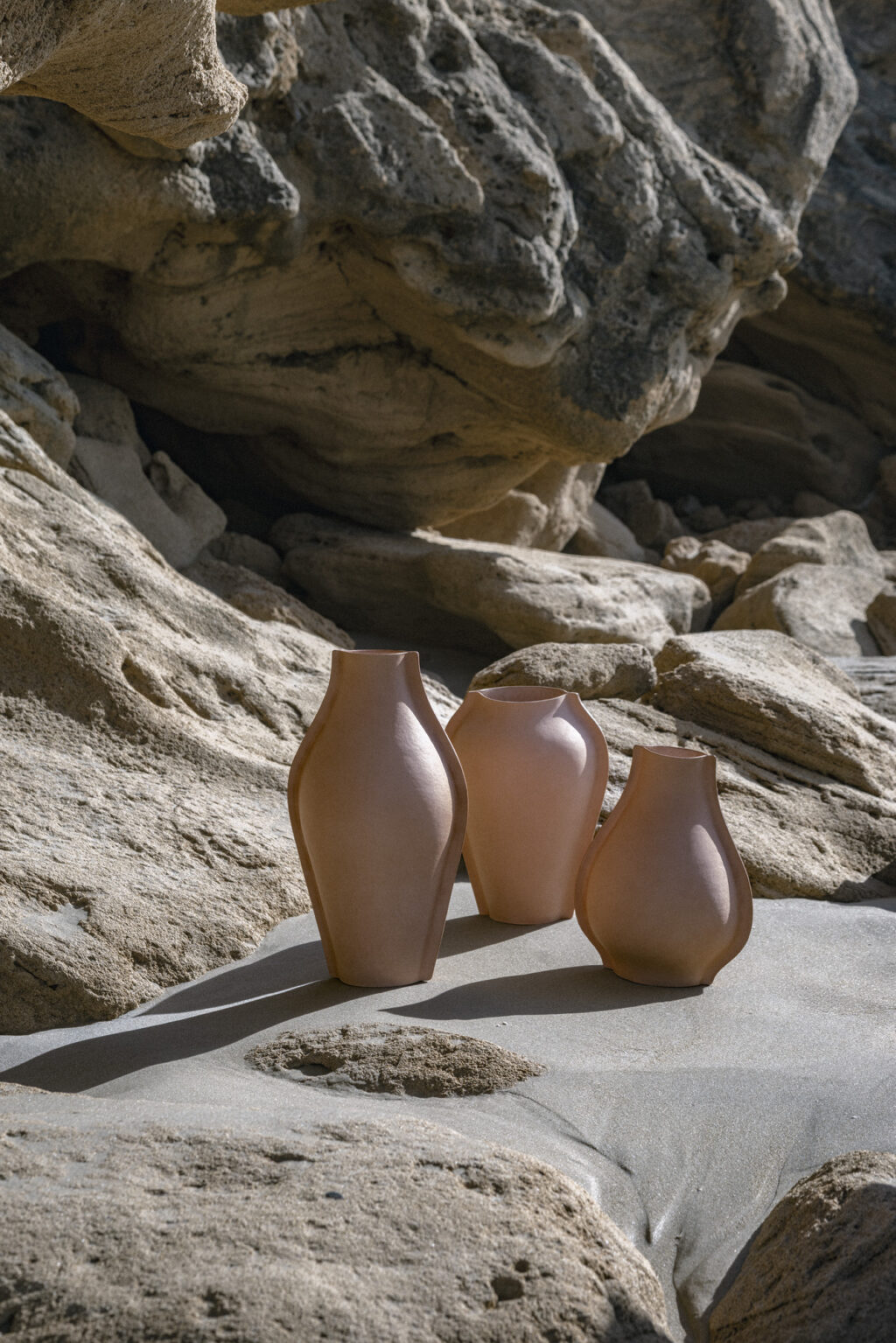
Luvaton Studio, founded by designer and artisan Talia Luvaton, sits at the intersection of traditional craftsmanship and contemporary sculpture. The studio specializes in the ancient technique of wet-forming, transforming vegetable-tanned leather into structural, organic vessels. Each piece is a dialogue between the rigid and the fluid, celebrating the raw, tactile nature of the material while pushing it toward architectural forms. Through a meticulous, slow-making process, Luvaton creates objects that are not merely functional but serve as silent anchors in a living space.

Growing up in a family of master craftsmen, with both parents working as silversmiths, Luvaton developed an early sensitivity to material, detail, and the rhythm of making. Today, she applies the meticulous discipline of a silversmith to the organic unpredictability of leather—balancing precision with intuition, and tradition with radical experimentation.
For the first time, Talia Luvaton will present her work at Milan Design Week 2026, having been selected to exhibit at SaloneSatellite, the international platform for designers under 35 at Salone del Mobile. At her booth, she will showcase a selection of sculptural leather vessels alongside a new project created especially for the occasion.
TRACE, presented for the first time, is a sculptural vessel that translates human movement into form. Originating from observational drawings of the human body, the project evolved into a new formal language of fluid, three-dimensional objects. Using traditional wet-forming techniques, each piece is shaped by hand into spatial forms that balance tension and softness, as the material responds to pressure, moisture, and time.
Alongside TRACE, Luvaton will present additional collections including TOHA, SLICE, REBLOOM, and HEALED — a series of tattooed vessels created in collaboration with professional tattoo artists who tattoo directly onto the leather using electric needles. Together, the works offer a broader view of her practice, positioning leather as a structural and expressive material within a contemporary international design context.

How has growing up around craftspeople shaped the way you approach leather?
Growing up with parents who are craftspeople, working as silversmith, gave me a deep respect for material and for the act of making. I was exposed from an early age to hands-on processes, precision, and a strong attention to detail.
At the same time, there was always an understanding that material carries meaning — that it’s not just about the final object, but about the process behind it. I carry that approach into my work with leather, translating it into a more spatial and sculptural scale.

What has working with leather taught you that no design program could?
Humility – and the necessity of trusting the process. Leather is a living, organic medium with its own memory and will. No matter how perfect your 3D model or technical drawing is, the material will always have the final say once it’s wet. It has taught me to listen—to slow down and work in a true dialogue with the medium rather than simply imposing my will upon it. It’s a constant lesson in embracing unpredictability and having faith that the material will find its ultimate form.


What detail in your pieces might go unnoticed, but matters deeply to you?
The internal “skeleton” of the piece. It is often surprising to people that these vessels are entirely self-supporting—there is no internal frame or reinforcement. Through the wet-forming process, the leather essentially becomes its own structure. That invisible internal tension, where a soft material achieves the stability of a rock, is the magic that allows the form to exist.

What does innovation mean when you’re working with such an ancient material?
To me, innovation isn’t about reinventing the material, but about deepening our dialogue with it. Leather has a primal, multi-layered history, and I’m interested in exploring its inherent potential as a structural, self-supporting medium while remaining rooted in traditional wisdom.
True innovation often emerges at the intersection of worlds—merging the discipline of ancient craft with a fluid, contemporary aesthetic. It’s about allowing that tension to guide the material toward forms that feel both timeless and entirely unexpected.

What does “responsible design” look like beyond sourcing?
It looks like permanence.
Beyond using vegetable-tanned leathers and ethical sourcing, responsible design means creating “future heirlooms”—objects built to outlast trends both physically and emotionally. Real sustainability lies in the relationship the object builds with its owner; it’s about creating something so meaningful and durable that it is repaired and passed down, rather than replaced.

How do you imagine your objects aging within a home?
I imagine them evolving and absorbing the story of the space. Vegetable-tanned leather is one of the few materials that truly matures; it develops a rich patina, deepens in color, and records the passage of time. I want my pieces to witness the life around them, gracefully reflecting the history and the atmosphere of the home they inhabit.


If someone encountered a LUVATON piece without context, what would you hope they feel immediately?
A sense of curiosity that engages all the senses. I want them to pause and question the materiality—is it stone? wood? clay? I hope it sparks an instinctive urge to touch, to understand the surface through the hand, while revealing the earthy, unique scent of the leather. It should feel familiar yet unexpected: a material they recognize, behaving in a way they never anticipated.

Upcoming Exhibition – Meet Luvaton Studio in Milan: Milan Design Week 2026 – SaloneSatellite (Fiera Milano, Rho) April 21–26, Hall 5, Booth E13