By Kimberly Haddad
During the course of our lifetime, we experience many extraordinary events. Some of these instances leave us with a deep sense of gratitude and self-awareness. They stir love in our hearts for ourselves and those in our closest circle. Others require us to confront our darkest emotions like sadness, anger, and denial. And there are moments that drive us out of our safety bubble and into curious spaces, encouraging us to reexamine our beliefs, values, identity, and what truly matters to us.
In 2019, I endured my first body suspension ritual. You may already be familiar with this ancient tradition, or it could be entirely new to you. Nonetheless, this transformative practice involves piercing the body with large, sterilized metal hooks in order to suspend the person solely by their skin. Throughout history, body suspension has been respected and utilized by various cultures for varying reasons that I will speak to later on. As for myself, it was a sacred rite of passage and a meaningful milestone in my journey of self-discovery and healing.
After my tumultuous breakup with a man who I once considered to be the love of my life, I realized it was time to rewrite my story, as cliché as that may sound. The reality I was used to no longer resonated with me, but moving towards true happiness seemed like a difficult task. I wanted change desperately, but I was always resisting it. In hindsight, I now understand that fear was what had been keeping me stuck. Celebrity photographer Norman Seeff once taught me that fear, like any emotion, has two sides. It can either paralyze you or guide you to where you need to be. He stressed that fear should be used as a tool for navigation and growth, not as a signal to retreat. The places you are too afraid to explore are likely where you’ll find the greatest magic. Going through this ritual helped me discover parts of myself I never knew were there. It gave me the courage to be the woman I always knew I could be but was hesitant to fully accept. It showed me that real transformation required me to wholeheartedly welcome the unknown, use my pain as a source of wisdom, and trust that all I desired awaited me on the other side of it. With each mindful breath, I ascended, sloughing off my former self like a snake shedding its outgrown skin.
It has been half a decade since that day, and as I navigate yet another major shift in my journey of self-discovery, I decided that a second body suspension would be the perfect way to treck forward. The idea of another suspension had been on my mind for a few months as I found myself reminiscing about parts of my life that had unintentionally slipped away. I realized I was still carrying around shame related to those moments, and it was time to release it. Feeling disconnected from the suspension community and the people I once knew in the scene, I delayed re-engaging. However, as the universe consistently provides for those who ask, I was connected with someone who was interested in my intimacy coaching services. During our initial phone call, he mentioned seeing photos of my first suspension five years earlier, which had inspired his recent acts. As we continued our sessions together, we uncovered the many parallels in our paths and quickly became friends. Naturally, I was there to witness his second suspension, where he bravely hung inverted from hooks in his knees. He then introduced me to a new group of suspension facilitators who guided me in mine just three weeks later. It felt like everything had come full circle, and I am extremely thankful.
ANCIENT ORIGIN
Alright, I understand that the idea of puncturing the skin with large metal hooks might have made some of you uncomfortable, but for those of you still here and reading, I thank you for your curiosity. Body suspension has a rich history spanning thousands of years across various cultures, such as India, the Middle East, and North America, traditionally practiced for sacred rituals. In the modern era, flesh hooks and suspension have evolved as a form of expression and performance art within the piercing and body modification community. Individuals participate in this practice for many reasons, whether it is to pursue spiritual enlightenment, push their limits, or purely for the adrenaline rush that comes with it. Each person’s motivations are rightfully unique and distinctly their own.
“I went into hook suspension blindly, to be honest,” said Carlos Medina, a team member of Ethereal Metamorphosis Suspensions. “No research yet no hesitation. I have no idea what drew me to it, but I know why I go back every time. I’ve been battling depression for a long time, and a suspension ritual takes me to a place that is not here. It’s an escape from life for a moment. It reminds me that if I can do that, I can do anything. You are stronger than you think you are.”
Human suspension dates back around 5,000 years and was first recognized among devout Hindus in India. During this time, the exploration of body- mind connections and the idea of using the body to transcend physical limitations were central to spirituality and daily life. A significant Hindu festival that highlights piercing rituals is Thaipusam, observed by the Tamil Hindu community during the full moon in the Thai month of the Tamil calendar, typically falling in January or February. This festival honors the victory of the Hindu deity Murugan over the demon Surapadman. During this time, devotees seek forgiveness, good health, and peace in the upcoming year from Lord Murugan, who is the son of Lord Shiva.
While body suspension was a symbolic gesture of faith, individuals would also pierce their bodies with metallic objects like needles and rods, often through their cheeks or tongue. They would walk over hot coals or carry symbolic burdens of gratitude, such as milk pots or heavy ornaments. By performing such actions, they believed they could cleanse their sins and reaffirm their Hindu faith. However, due to laws prohibiting public self-mutilation, extreme body piercing during the festival is now greatly limited within the country.
The Mandan Native American Indians residing along the Missouri River in present-day North Dakota also practiced similar suspensions as part of the four-day Okipa ritual. For centuries, the tribe conducted a rite of passage ceremony where young warriors were pierced and suspended to honor the creation of the natural world and strengthen their unity through self-sacrifice. A tribulation of endurance and stamina, these young men engaged in the sacrament to show their courage and grow into Mandan leaders.
Many credit modern body suspension to Fakir Musafar, an artist, shaman, and master piercer known for his exploration of indigenous body decoration and self-mutilation. Engaging in what he deemed “body play,” Fakir pushed the boundaries of his physical form through practices such as hook suspension, hourglass corseting, and weighted piercings. He even pierced his own cheeks with spears. Believing body modification to be a spiritual route to altered states of consciousness, Fakir thought that changing one’s physical form in such ways could unlock deeper levels of awareness and uncover our purest selves.
A Ceremonious Evolution
Like the Mandan Indians, my decision to undergo another body suspension, with more to come, represented a transition into a new chapter of my life where I shed the old and stride forward with renewed energy. While some may write letters to their past selves, kindle magic candles amid a circle of crystals, or release negative emotions through the aid of psychedelics, my transitional ceremony is that of body suspension. Is a ritual in which I willingly present my body as a sacrifice to my spirit, helping rejuvenate my mental toughness, willpower, and boundless self-expression.
Although I did not experience fear during my first flight, the days leading up to this current journey left me filled with anxiety. Being detached from my usual routine of exploring my body’s pain threshold, I doubted my readiness for the experience. I questioned the alignment of my heart and mind, considering that my prior suspension was also an act of love for another. Feeling unsure of my ability to handle the physical and emotional strain, I feared failure and potential embarrassment. I pushed myself to meditate daily, pray, and infuse intention into every step of my preparation. As I progressed, I realized I was placing too much pressure on myself and expecting a certain result. I knew I had to shift my mindset towards the belief that I was capable of anything. Like the Kabbalists teach, I focused on having faith rather than expectation, trusting that there is always a plan for me, regardless of what I may perceive. The morning of, I let go of all ego-driven thoughts and anticipations. I committed to showing up, being present, and accepting any outcome that awaited me. If I didn’t feel ready, I would allow myself to leave without judgment.
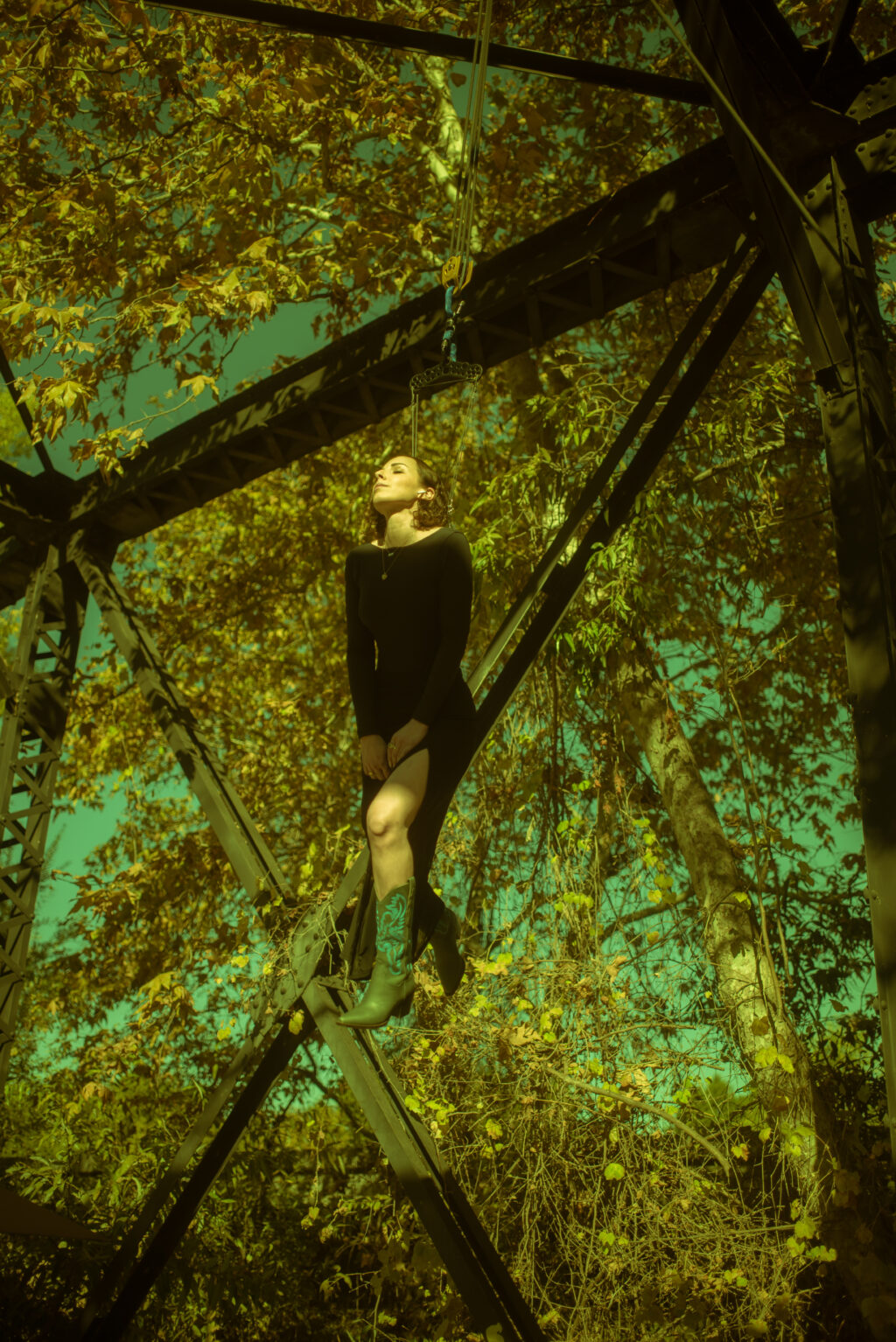
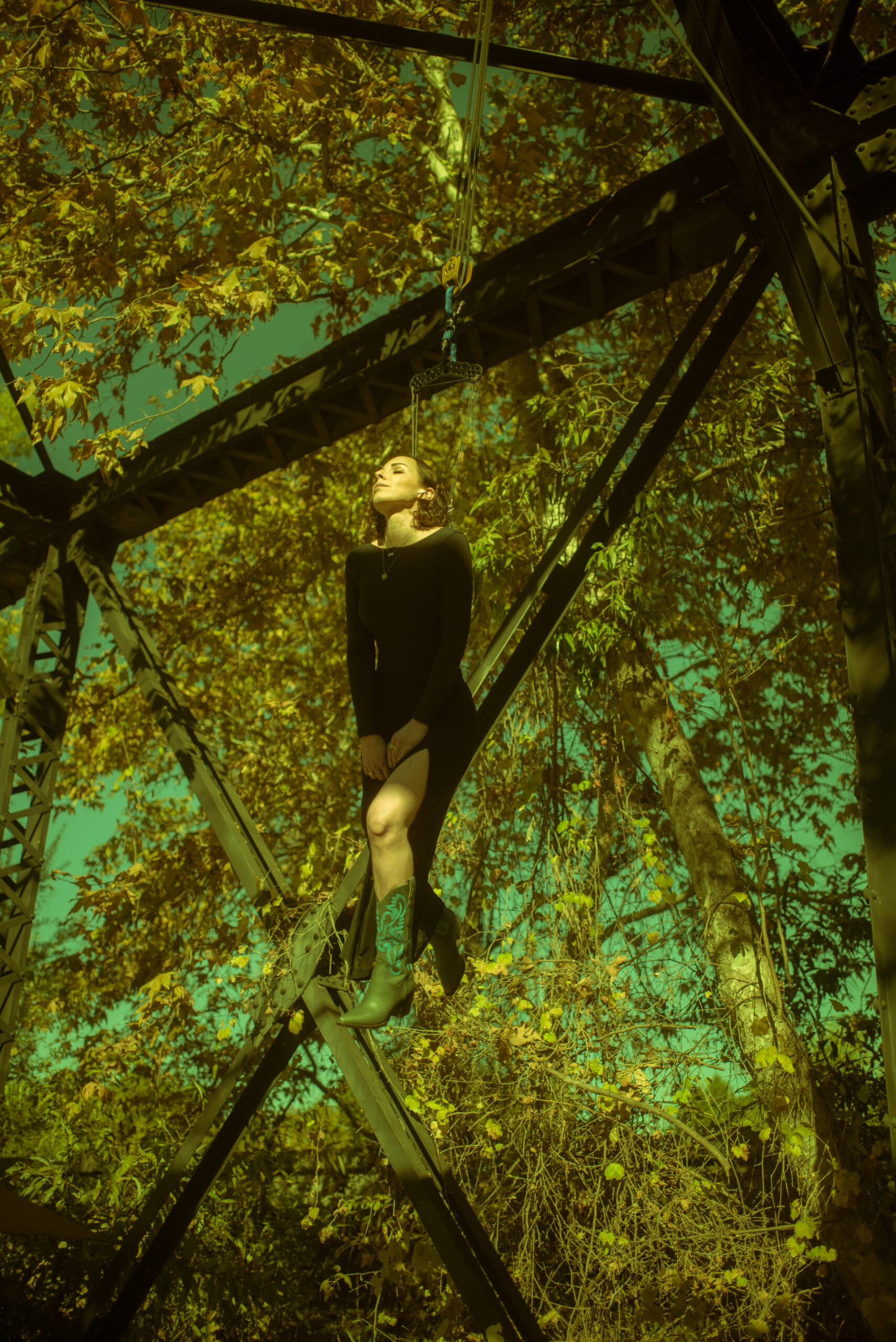
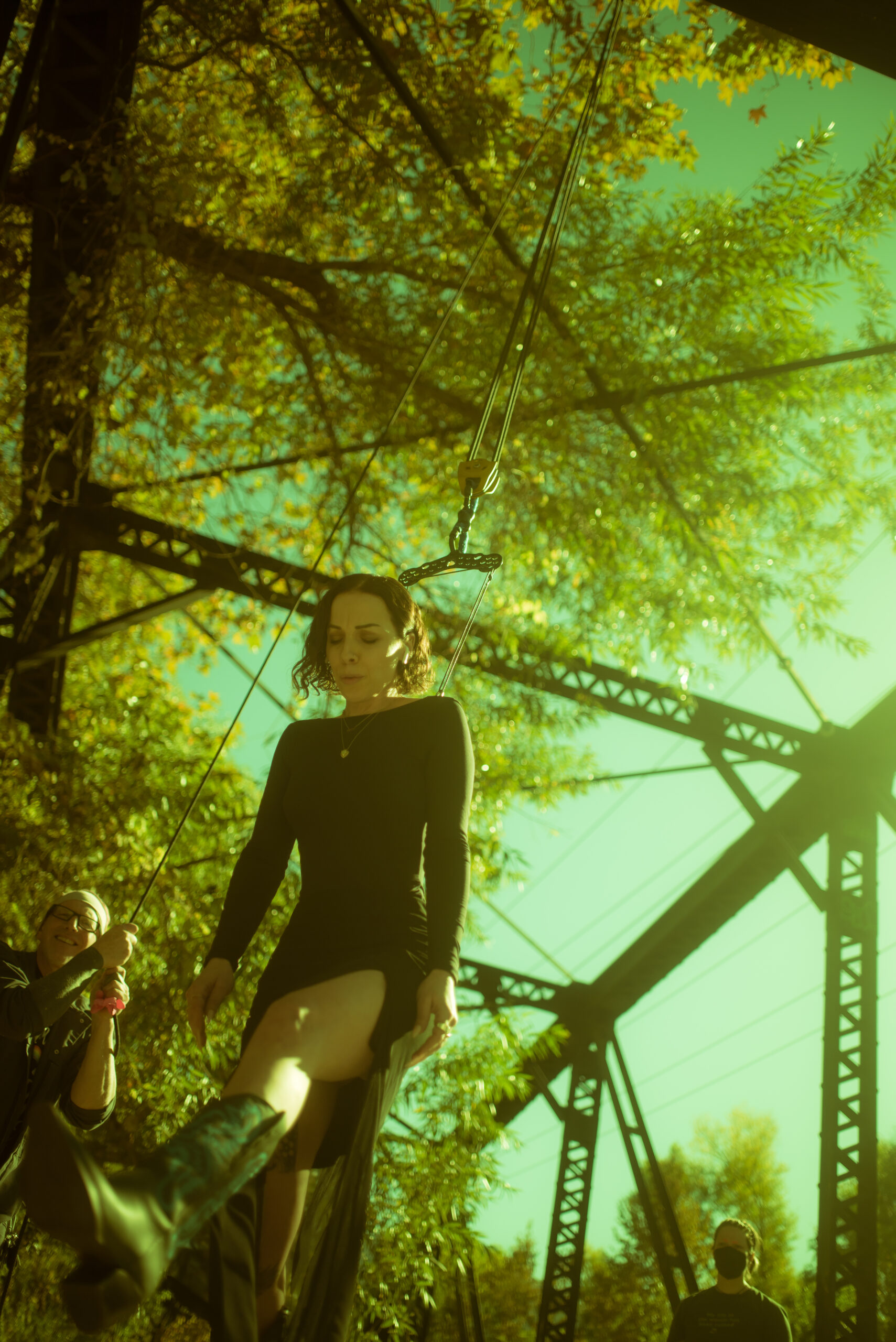
On that Sunday afternoon, I arrived at Sweetwater Bridge along Highway 94. From a distance, I saw two individuals dangling beneath the historic span, surrounded by endless biking and hiking trails. One man was suspended from two hooks in his chest, while a woman hoovered horizontally above a table with hooks in her elbow and knee. After they were lowered, it was my turn. Bibi, a suspension performer and member of the Ethereal Metamorphosis Suspensions team in San Diego, led me to a tent where she squeezed the flesh of my upper back and suggested three piercing locations for a suicide suspension, a common position where the body hangs vertically to the ground.
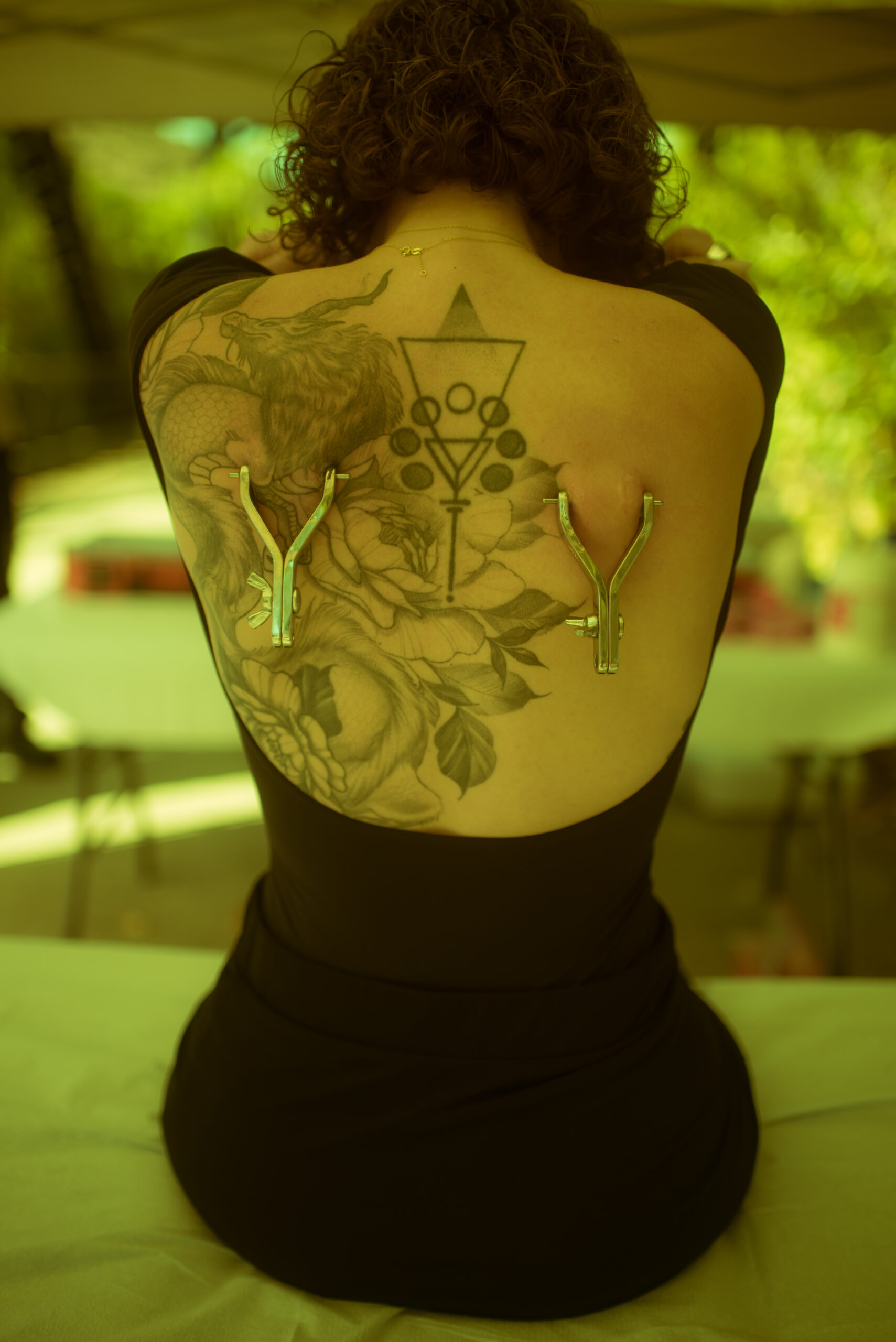
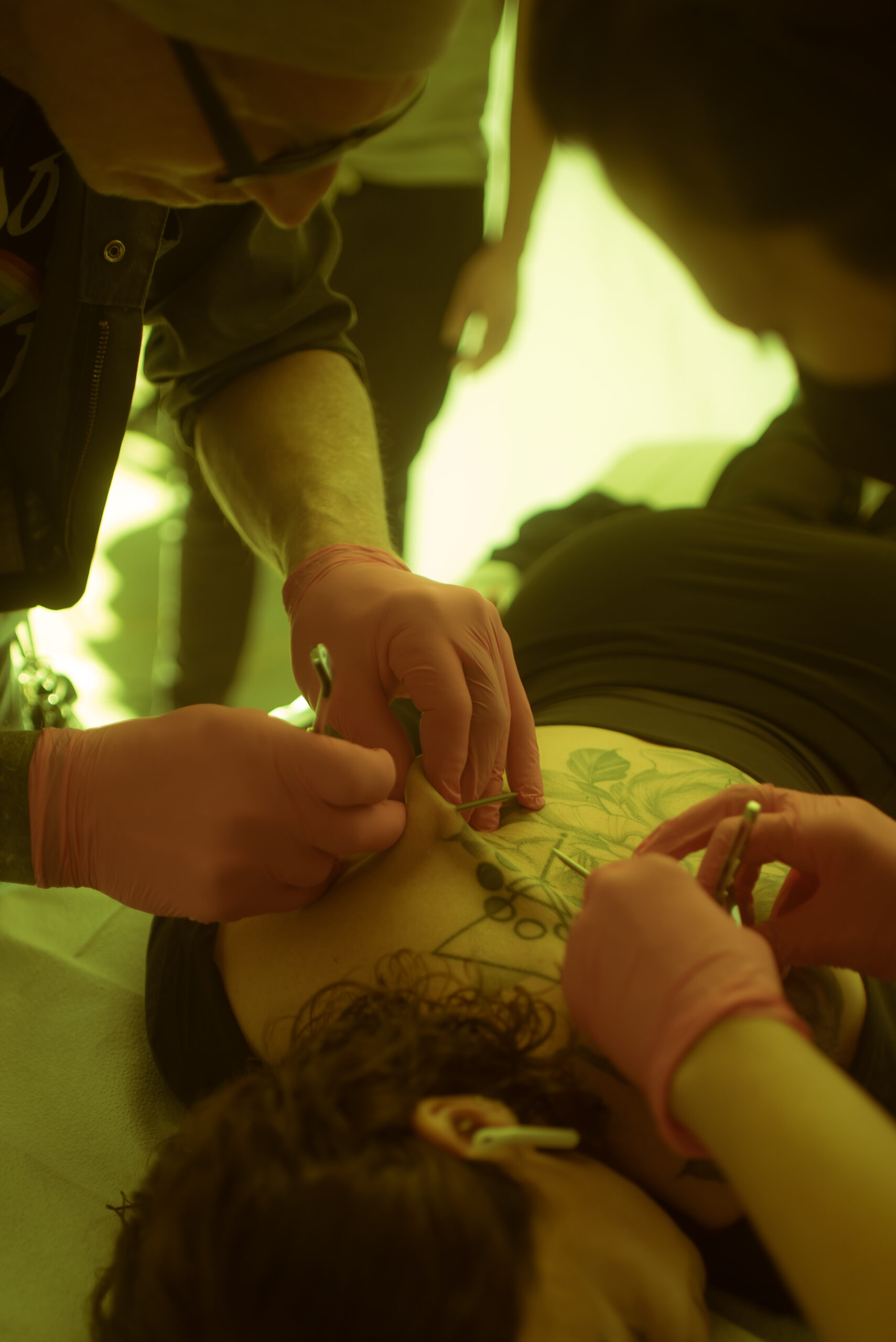
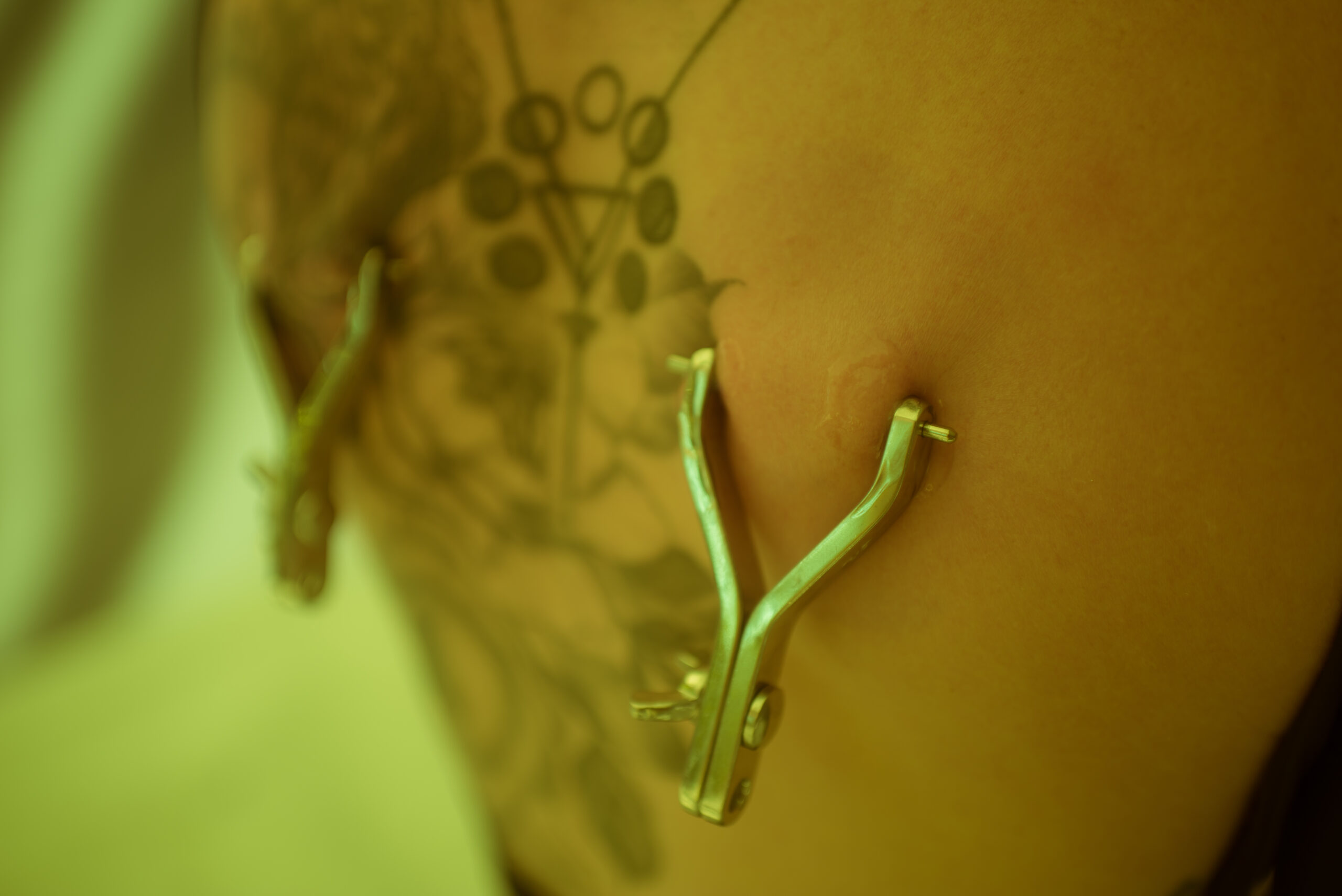
After completing the marking process, I chose to block out my surroundings and put in my EarPods. I calmly laid on the massage table, listening to the playlist I created for the occasion. The power of music is truly remarkable; certain songs can take you to another place or help you connect more deeply with your body and senses. Bibi and another facilitator, Erin Sloan, prepared the areas of my back and began the first round of piercings, instructing me to take three deep breaths. On the third count, as I exhaled, they deftly pierced my back in unison. My skin made a crunching sound as the metal passed through the layers and created a pathway for the Gilson hooks. When I was ready, they lifted me into a seated position where I could gently move my body and reacquaint myself to the tight feeling of the hooks. I stretched my arms in front of me and slowly hugged myself as tears started to fall uncontrollably.
Flying High
Frequently questioned and undoubtedly painful, the feeling of body suspension involves pulling, burning, and a mixture of strange and painful sensations that can’t really be compared to much else. Occasionally, the pain can be all-consuming, leading to nausea, vomiting, fainting, or panic attacks. Yet, for the majority, the physical discomfort is quickly forgotten once in the air, entering a trance-like state of weightlessness without any pain at all. This transition usually happens after the initial shock and disorientation that occurs when one is first lifted by the hooks into a suspension, especially for newcomers.
The most intense pain I experienced was the prelude of tugging once I was fastened to the rig and pressure was applied. For me, this phase is always the hardest, as even the slightest movement causes the skin to stretch like a tightly wound rubber band. The pain grew so uncomfortable that I questioned whether my body was even registering it or if it was all in my mind, despite having gone through it before. At that point, all you could do is submit.
Many people wonder how the hooks stay in place without tearing through the skin, but there are two main reasons: the weight is evenly distributed across multiple points on a specific area (in my case, four points), and the fascial layer beneath the dermis and epidermis allows the skin to withstand high levels of tension. Although tears may occur in delicate areas like the knees or elbows, experienced facilitators can often prevent this by careful monitoring. Witnessing a suspension in real time gives you a whole new appreciation for the resilience of human skin and our bodies as a whole.
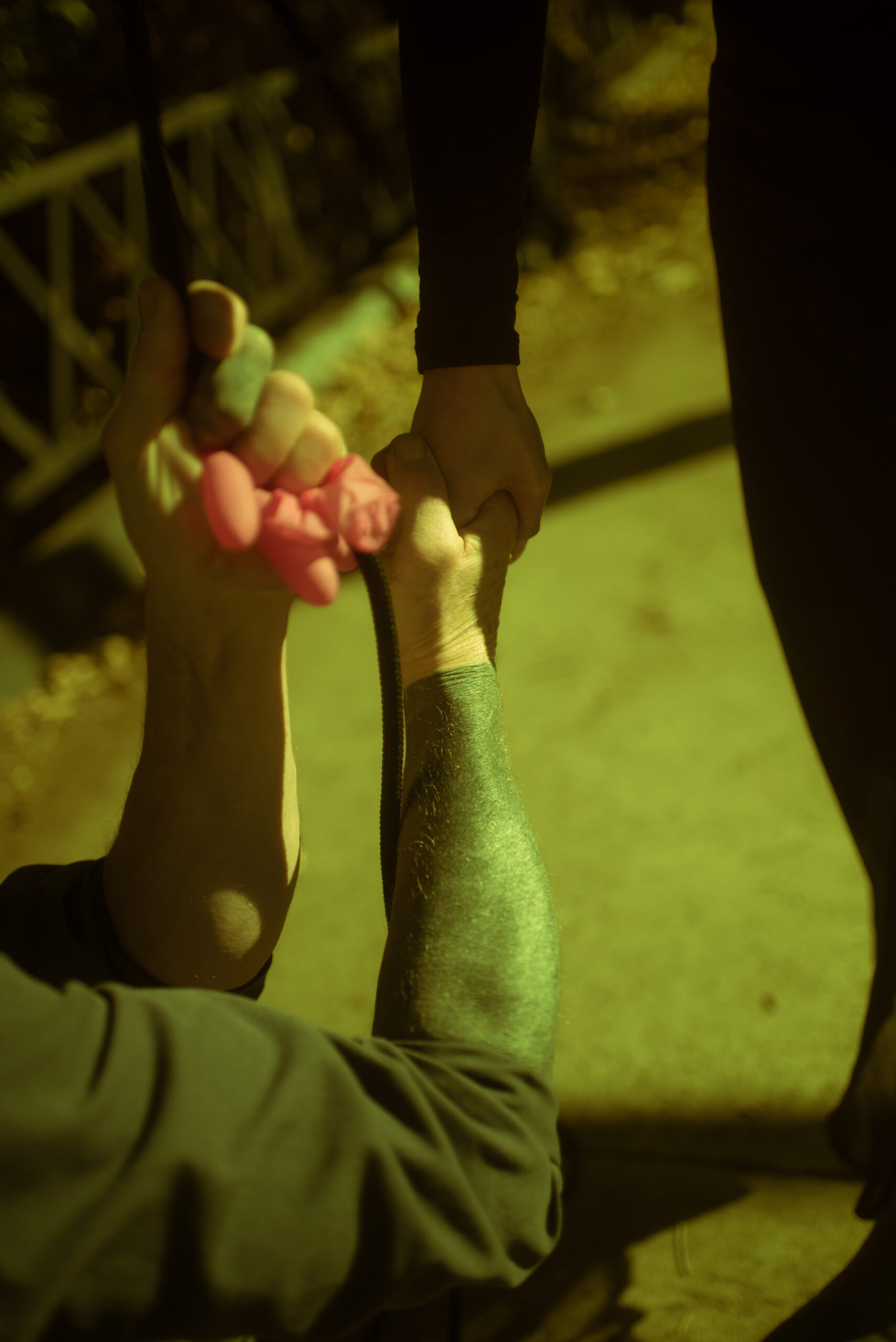
Still hesitant to rise gracefully, I mustered the courage to break out of my comfort zone and try something new. Taking up Erin’s offer, I seized full control, using my own efforts to ascend and detach from the earth below. It was a moment of absolute perfection, pushing the edge of my physical and emotional strength in ways that were entirely new to me. One might think that pulling oneself up is easier than depending on someone else, but in reality, it’s the opposite. However, every moment of this empowering challenge is worth the struggle. During suspension, a moment arises where fear and panic slowly seep in. It’s a strange state to be in, with your body clinging to the ground while your mind grapples with yielding to the hooks’ pull. This is where the mental battle begins. It’s a surreal experience, especially when balancing on your tiptoes. It’s the ultimate test of trust and surrender, where you must let go of control and have faith that you truly are stronger than you think you are. I carefully piled one hand atop the other, feeling the pressure intensify. I let out a groan of agony. Finally, both feet left the ground and Erin gripped my trembling hand as I breathed through the rush of adrenaline.
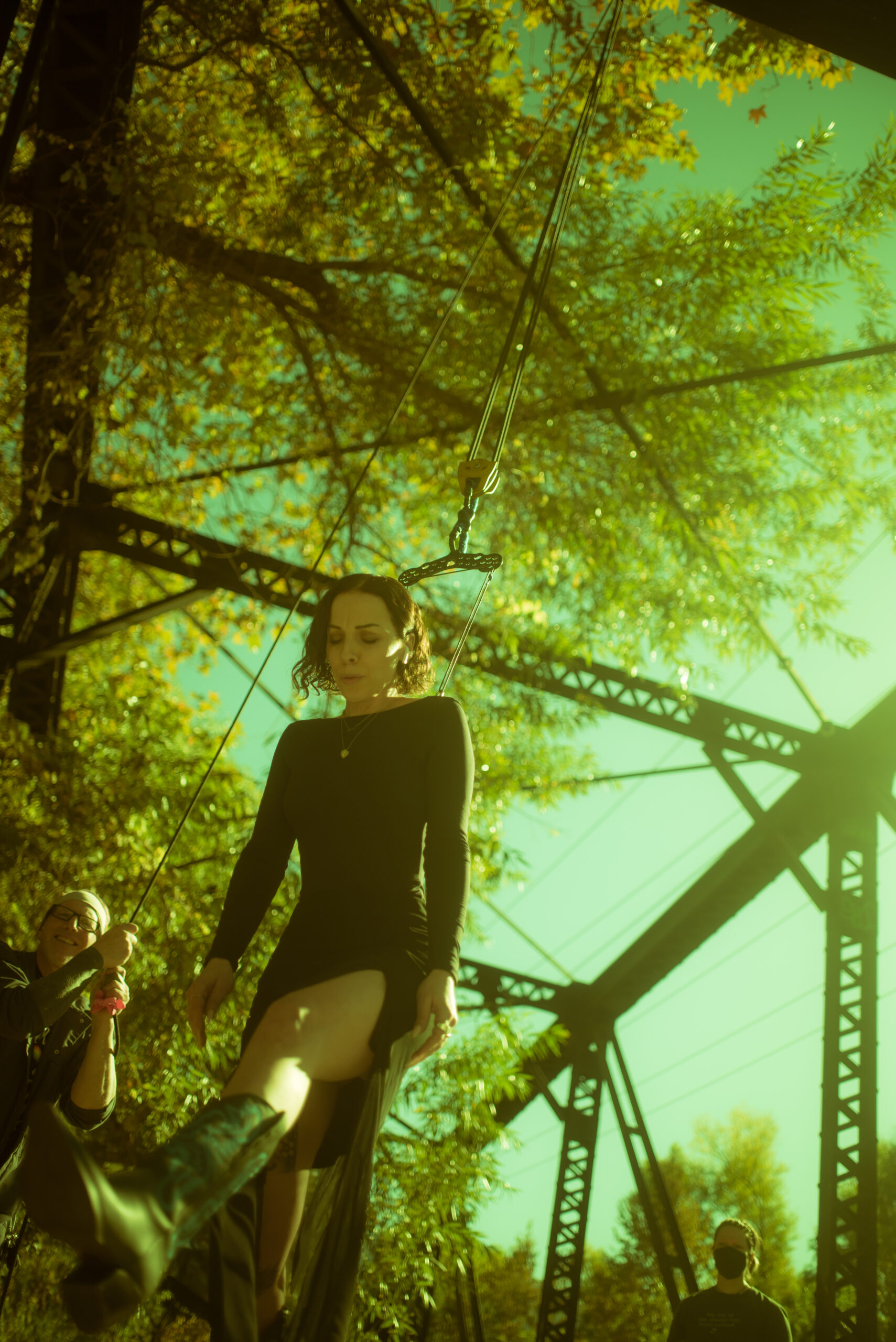
When I settled into my body, Bibi gently grabbed my hips and swung me through the air, while Erin elevated me closer to the peak of the bridge. Tears welled up and poured down my cheeks once more. It was not due to any lingering pain, for that vanished within minutes of taking flight. No, my tears were a manifestation of real joy, a deep yearning finally fulfilled. To reconnect with this part of myself, to intimately and spiritually reconnect with my body, to present myself before a new group of friends and soar for a second time—it was nothing short of magic.
Body suspension is often misunderstood and judged by many as a negative and dangerous activity, including my own parents. Many recoil at its thought, deeming it as diabolical, inhumane, and self-destructive. However, those who actually partake in it understand that these perceptions couldn’t be further from the truth. It is a unique practice that goes far beyond understanding through observation, one that can only be truly comprehended through direct participation.
I must confess to being something of an adrenaline junkie, always drawn to thrill-seeking adventures. I have wildly plummeted from planes, flung myself from the towering ledge of one of the world’s highest bungy jumps, and blindly descended into the eerie darkness of New Zealand’s Waitomo Caves teeming with luminescent creatures. Yet nothing compares to the euphoria I feel during body suspension. Nothing grounds me and connects me to my physical self like body suspension. The peace that accompanies it is unmatched. It is a transformative experience that opens a door into the deepest parts of my consciousness, a cathartic release that reveals a hidden side of myself that remains unseen in everyday life.
Photography MOSS @richie_tenenbaum____
Body Suspension ETHEREAL METAMORPHOSIS SUSPENSIONS @etherealmetamorphosisig
Suspension Facilitators BIBI @airdancerbibi
ERIN SLOAN @serpentsofthedamned
Team Member CARLOS MEDINA @loslives_undead