
A CULTURAL CRITIQUE OF ALGORITHM-DRIVEN SAMENESS THROUGH FASHION AND ONLINE BEHAVIOR

WORDS BY NINO GOJDA
When Eugène Ionesco premiered Rhinoceros in 1959 at the Schauspielhaus in Düsseldorf, the audience in suits and pearls had no reason to think his “absurd drama” would one day mirror the experience of a morning scroll on TikTok. Ionesco, a founder of anti-theatre who saw the world as a tragicomic farce, was not writing about animals. He was mapping how mass behavior takes hold.
Drawing from the political climate of 1930s Romania, Ionesco watched as friends and intellectual peers gradually aligned themselves with fascist ideology. He described the process as a disease—rhinoceritis. In his diaries, he tracks the change in real time: arguments harden, skin thickens into something impenetrable, and speech collapses into collective trumpeting. In Rhinoceros, the transformation is both physical and psychological. The individual sacrifices their face—their identity—in exchange for a horned mask that guarantees safety within an aggressive crowd. Replace “ideology” with “algorithm,” and the metaphor begins to feel less historical.
THE DIGITAL HERD
The speed of the surface world has accelerated to the point where images spread faster than reflection. In that pace, self-expression gives way to the urgency of catching a trend before it disappears. It’s already visible across artists, dancers, and fashion houses, where work that once developed more creatively is now increasingly shaped by the demands of Reels and TikToks.
A common defense is that this system is necessary for survival. But when visibility is tied directly to income, creative work becomes inseparable from performance metrics. As a result, our era is witnessing an immense intellectual sell-out. Vision is often traded for reach, and originality is compressed into what can circulate.
Looking at Ionesco now, it’s difficult not to ask whether there’s any real difference between us and those who once succumbed to ideology. The gestures repeat, the language converges, the same masks reappear—each of us folding into the comfort of communal belonging.
What we now perceive as “new” is often not the result of a conscious search for form, but the moment a visual language reaches saturation. Discovery is harder to access. Designers speak openly about the difficulty of working through the constant influx of references online. To find something original often requires searching elsewhere—archives, books, physical spaces, or the natural world.
RHINO-CORE
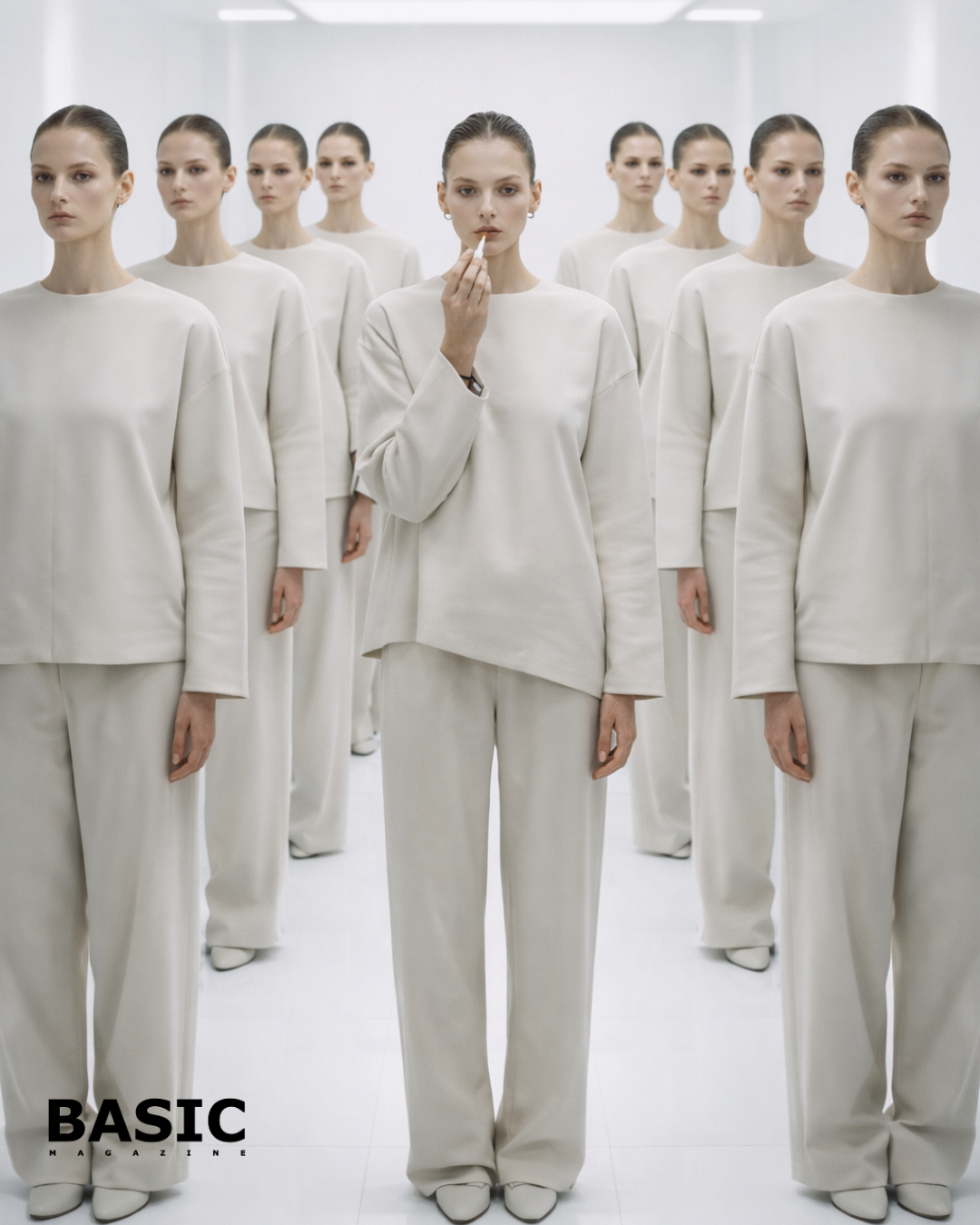
RHINO-CORE is the defining cultural condition of our decade. It isn’t defined by any single look or trend, a returning Y2K obsession, or a particular fabric. RHINO-CORE names the aesthetic of absolute, uncritical assimilation—the point at which conforming evolves into the fashion statement itself.
In Ionesco’s play, the character Dudard casually rationalizes the town’s transformation: “What could be more natural than a rhinoceros? Who can say where the normal stops and the abnormal begins?” The same psychological mechanism operates within the TikTok and Instagram feed. The algorithm does not reward variation; it favors replication. When a dominant style hits the FYP, thousands of users do not simply draw inspiration—they replicate the same outfit, the same audio, the same camera angle, and the same deadpan expression.
A clear example of this is the “Get Ready With Me” (GRWM) ritual. In these videos, we witness a digital metamorphosis: an individual starts in a bathrobe and, step by step, applies an algorithmically approved mask. It turns into a public performance of shedding one’s own skin in order to adopt the uniform of the herd—whether it’s the slicked-back bun, the “clean girl” makeup, or the oversized streetwear rotating that week. We don’t watch these to discover something new or get inspired; we watch them to learn how to correctly grow our own horn.
This is digital rhinoceritis. Creativity, once tied to personal flair, becomes a race to decode and mimic the prevailing visual code. We begin to lose our individual faces, trading them for the safety of a heavier, more impenetrable mask. It feels less like expression and more like alignment aimed at satisfying the algorithm. As Ionesco noted in the play: “Good men make good rhinoceroses, unfortunately.” Today, we might add: good creatives make the best clones.

THE PHILOSOPHY OF RHINOCERITIS
Ionesco’s rhinoceroses also point to a form of psychological relief. To become one is to stop doubting, to enter a world where decisions are no longer individual but composite. It offers release from uncertainty—in exchange for giving up one’s own voice. In the digital environment, this mechanism operates with even greater intensity. When a certain image or aesthetic appears everywhere, it begins to register as natural—not because it has been consciously accepted, but because it has become part of the environment we move through.
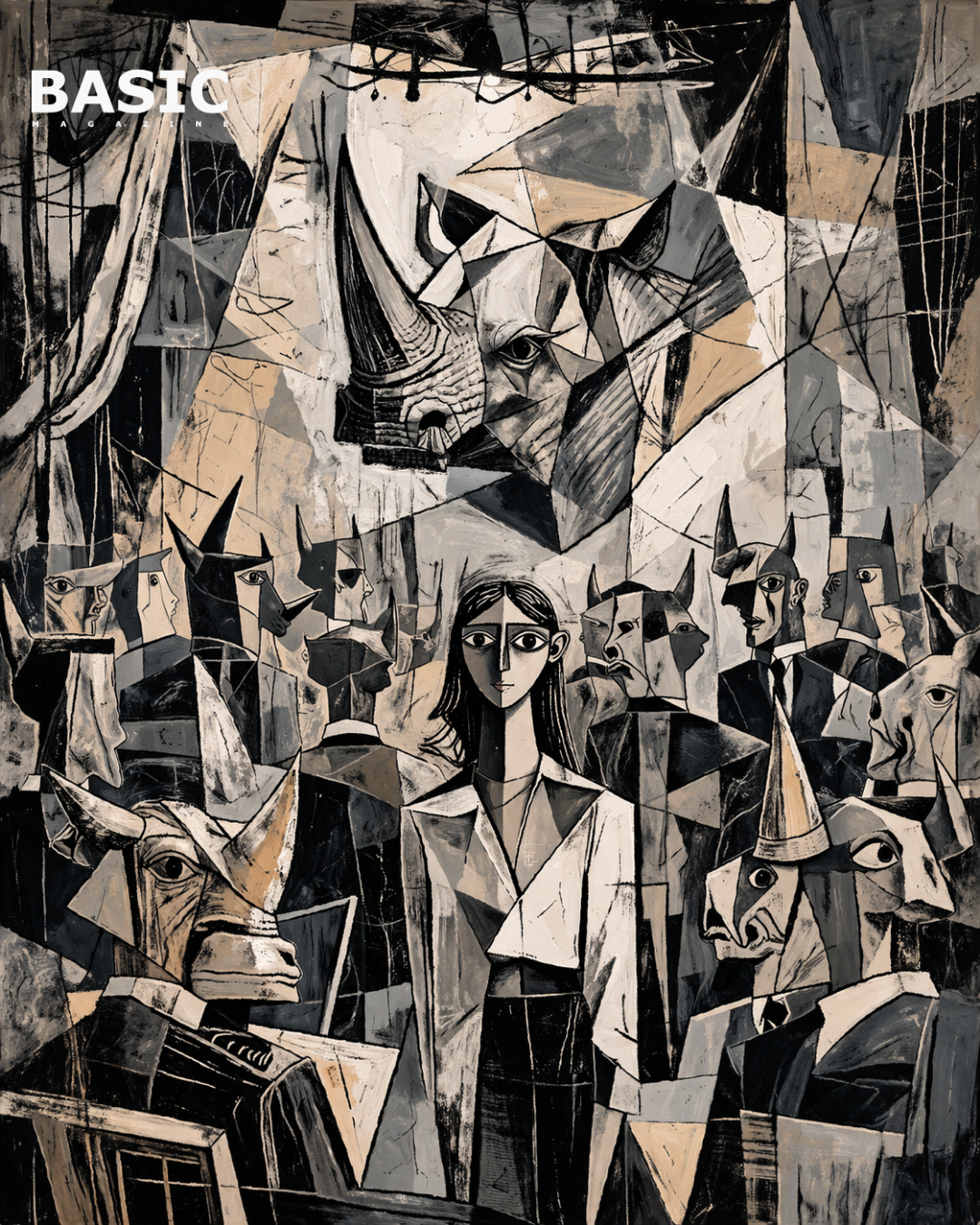
BÉRENGER’S TRAGEDY: “I DON’T BELONG TO THEM, AND THAT DESTROYS ME.”
The saddest moment of the play is not Jean’s transformation, but Bérenger’s cry at the end. He wants to become a rhinoceros. He tries to produce the sound, to acquire that hard, unfeeling skin so he will no longer feel alone—but he cannot.
The swiftness of today’s trends can deprive us of the time needed to form our own taste. Taste develops slowly, through experimentation, mistakes, and personal reflection. The digital environment functions in the opposite way—it prefers immediate readability and quick, recognizable cues.
In 2026, the Bérengers of the world—those who refuse to submit—are not heroes. They are invisible. To resist the algorithm is to risk disappearance. To refuse the “uniform” is to be muted by the very technology that once promised us a voice. And yet, creativity does not disappear. The future of creation will always exist, but its direction depends on us—whether we remain loyal to the system or to ourselves, whether we bring forward something driven by instinct and thought or continue producing what gains the most traction.
In the end, the danger is not that we will stop creating. It’s that we will produce only what is rewarded, and forget how to create anything else.